
Building a Repeatable Automation Playbook Across Your PE Portfolio


Most PE firms we talk to believe the same thing about automation: build it well once in one portco, copy it across the portfolio to compound the value.
Finance is finance. Logistics is logistics. Accounts receivable is accounts receivable. So operating partners should be able to scale automation. Works in theory. Why should decreasing working capital tied up in inventory or unpaid invoices be different from company to company?
The reality is that the processes that seem to be the easiest to standardise — back-office workflows that exist in every company — end up being rebuilt from scratch.
This article explores reasons behind that gap, which processes can travel across a portfolio, and how to build a practical automation playbook that compounds across your holdings instead of a blank page at every acquisition.
Automation in PE is still largely once-off
The promise of portfolio-level automation “do it once, deploy everywhere” is distant from what works in practice. Why is it so difficult to replicate automation across the rest of a fund's portfolio after a successful adoption at one portco?
Portfolio companies don't enter and exit on the same timeline. Every portco has a different level of maturity. Every company has a different ERP (sometimes many of them). A different team. A different way is one person who has been running the process manually for fifteen years and whose workarounds are holding the whole thing together.
The one exception that seems to work consistently is core financial reporting (P&Ls, balance sheets have standard format). Even though the inputs vary wildly across portcos, the end output is standardised. Everyone is subject to the same accounting rules and everyone needs to produce the same formats for the same stakeholders, making the whole process replicable.
Now let’s take accounts receivable. There's no golden standard. One portco does factoring, another — credit insurance, a third has one person chasing invoices by phone and another sending increasingly frustrated emails. The process is fundamentally different in each one, even though the name on the box says the same thing.
The main reasons why the gap exists:
- Different ERP/CRM environments at every company
- Data quality and availability all over the place
- Some companies on spreadsheets, others partially digitised
- Local management resistance that varies significantly
- No shared baseline to measure ROI consistently
Investment Thesis is not a playbook
Every portfolio company acquisition starts with a Value Creation Plan. The investment team builds the thesis during diligence — margin expansion here, working capital optimisation there, a cost-out programme, a pricing reset, a digital play. The plan gets agreed at IC. Once the deal closes, the VCP gets delegated to the operating partner, who is now responsible for execution and monitoring.
Their challenge is that the plan is almost always framed at the level of metrics:
- Improve DSO by fifteen days
- Reduce order-to-cash cycle time by 30%
- Cut finance function cost by 20%
- Lift gross margin by 200 basis points.
These targets are left to OPs to figure out, usually through influence rather than formal authority over the portco.
Automation is one of the fastest levers to meet these goals. It moves margin, cash, and cost with relatively predictable timelines, and it doesn't require a strategic reset or a leadership change to deploy.
A once-off automation project that delivers results in one portco and then stops creates a fraction of the value a replicated programme does. Portfolio-level execution is where you find the real operating alpha.
Why automation doesn't replicate easily
People would love it to be lift-and-shift. Practitioners know it isn't — for a thousand reasons that are all individually small and collectively enormous. Here are the ones we see most often:
- The human factor. Change management is hard. Cultural differences between portcos can be a huge obstacle. Traditional sectors are used to the way things are done, and it's often political — different departments feel territorial about their processes, making it difficult for anyone to introduce change.
- System fragmentation. Portcos run different ERPs, different CRMs, different warehousing systems, and a long tail of legacy tools that no one wants to touch. One portco might already work on a modern cloud stack another on a bespoke 1998 system with three custom modules written by a contractor who has since retired. "Lift and shift" between those two environments means rebuilding most of the integration layer.
- Process variation. Even the same process has different owners, triggers, and exceptions in every company. It might be the same process on paper, but an entirely different operational model underneath.
- Scope creep. Once you start one automation, the portco team sees what's possible and wants to expand it. Scope grows, timeline stretches and the clean, replicable artefact you were trying to build becomes a custom job specific to that portco.
- Decision-making latency. Getting CEO and CFO alignment on something that crosses departmental boundaries takes time — especially when the OP is working through influence.
The result of all this is that something that could be replicated across the portfolio gets rebuilt from scratch each time. The playbook exists in principle but never accumulates in practice.
Which processes actually travel across a portfolio
Universal processes
These appear in almost every portco, regardless of sector. They're the foundation of any portfolio-level playbook.
- Order intake. Customers always send orders somehow — email, EDI, portal, a spreadsheet, a dedicated form. The intake channel varies, but the shape stays the same: read the input, extract the relevant fields, validate against the catalogue, push into the ERP. AI-powered document parsing and multi-channel intake make this one of the most repeatable automations in the portfolio.
- Accounts receivable and collections. Every company invoices, and most chase manually. The specific logic varies, but the underlying structure is consistent enough to build a reusable automation layer with configurable rules per portco.
- KYC and customer onboarding. Every B2B company needs to verify new customers. The exact compliance requirements differ by geography and sector, but document extraction, risk scoring, and workflow routing are the same problem everywhere.
- Vendor onboarding. Every company adds new suppliers. Form automation, compliance checks, and ERP sync are fundamentally portable.
- Working capital reporting. Every portco needs cash visibility. Automated dashboards and treasury reporting bots are almost built for portfolio-level deployment.
- P&L and business intelligence. Fund-level reporting requires a standardised view regardless of what sits underneath it. A standardised reporting layer built on top of different ERPs is one of the highest-leverage portfolio plays there is.
- Data cleansing and enrichment. CRMs and ERPs are usually messy. Automated deduplication and enrichment pipelines are applicable everywhere.
Sector-specific
If your portfolio concentrates in a sector, you get a second layer of repeatability.
- In manufacturing, production efficiency monitoring, materials procurement automation, and quality logging show up consistently.
- In distribution, logistics tracking, demand forecasting, and returns processing are portable.
- In B2B services, contract management, renewal tracking, and utilisation reporting apply across the board.
The Playbook: start small, prove it, then scale
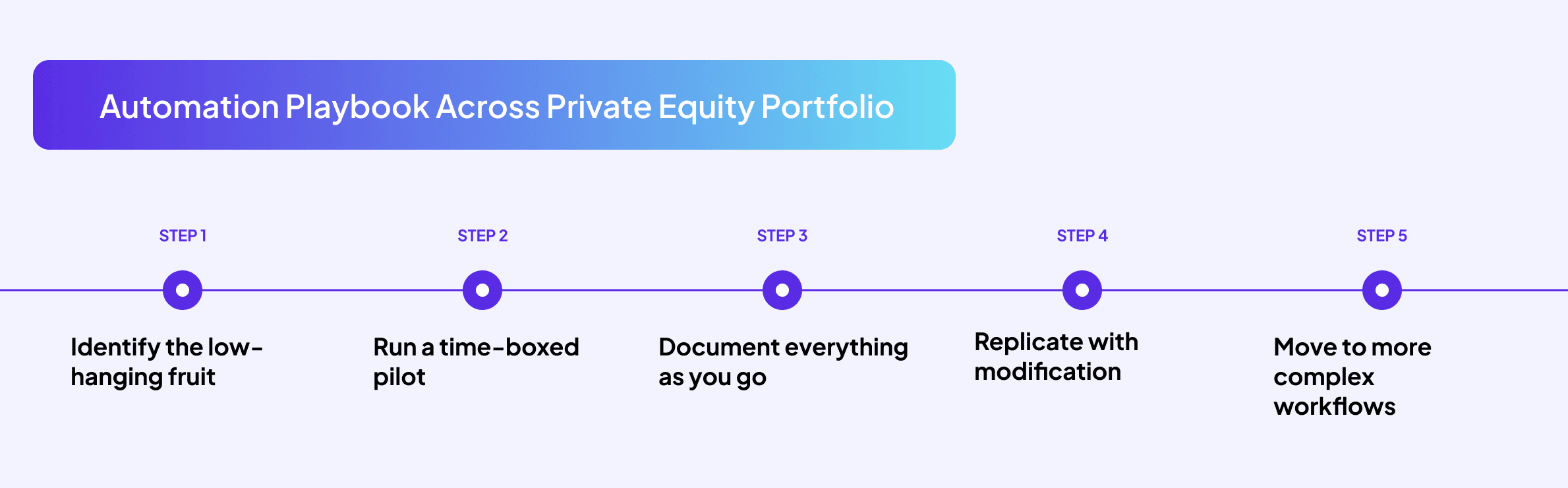
The goal is to build a working artefact in one portco that you can then carry into the next. A portfolio-wide automation programme won’t be invented on day one, but with this framework you will bring compounding effect with more and more portcos.
Step 1 — Identify the low-hanging fruit
Start by choosing the right first portco and the right first process. Those are two separate questions.
For the portco, look for: willing management (a CFO or COO who is actively asking for help), relatively clean data, and a clear operational pain point that someone is already losing sleep over.
For the process, look for: a clear ROI baseline (Days Sales Outstanding, order processing time, collections rate, error rate) and universality — a process that exists in other portcos in broadly the same shape, not one that's specific to this company's business model. Don't start with something bespoke, but boring and replicable.
Step 2 — Run a time-boxed pilot
Define the scope, the input, and the measurable output before you start. Set a 6-to-8 week delivery window with clear success metrics. The time-box matters: it forces the scope conversation early and stops the initiative from drifting into a permanent project.
Step 3 — Document everything as you go
This step determines whether you end up with a playbook or another once-off deployment.
Capture the process map, exceptions, integration touchpoints. Note specifically what was portco-specific and what was universal. The portco-specific parts are the ones that will change in the next deployment. The universal parts are your actual playbook.
Step 4 — Replicate with modification
When you take the automation into the next portco, use the documented playbook as the starting point. Expect around 30–40% customisation. Design for the other 60–70% to be genuinely reusable.
Track the cost of each deployment and the value delivered. The data you're building — unit economics of automation per portco, time to deploy, value captured — is what justifies scaling the programme further and what gives the OP a defensible case to the IC.
Step 5 — Move to more complex workflows
Once the low-hanging fruit is proven, identify higher-complexity, higher-value initiatives that are aligned with specific VCPs across the portfolio. Build a portfolio-level automation roadmap, not just a collection of company-level projects. The point is to compound automation capability as an asset the fund owns.
Good governance, without overcomplicating it
A few things need to be in place from day one, regardless of which process you're automating:
- Human-in-the-loop checkpoints. Decide up front which decisions stay with humans and which are automated. "The agent processes orders up to £5,000 autonomously; anything above routes to a reviewer." That's a governance decision that needs to be made explicitly.
- Audit logs. Every automation needs a record of what ran, when, and what it changed. This matters for internal controls and for reporting.
- Impact tracking. Every initiative should have a metric it's meant to move — DSO, margin, headcount avoided, cycle time — and that metric should be measured before and after.
- Change management and ownership. The portco team needs to own the process after go-live. An automation that the team resents or quietly works around will degrade within months. Governance includes full and clear handover on who runs it, who maintains it, who's accountable for it.
Final remarks and limitations
Repeatable automation across a portfolio is not plug-and-play and it won’t be in the foreseeable future. It requires a structured methodology, an execution partner who understands both PE dynamics and operational processes, and management teams willing to change. When any of those three is missing, the playbook won’t succeed.
The funds that crack this compound the value. Every new portco acquisition becomes faster to improve and each deployment makes the next one cheaper. The playbook gets sharper with every iteration, and the operating team gets faster at spotting which processes to address first.
Where to start
If you're an operating partner thinking about where to start with the low-hanging fruit in one portco, or already looking at how to scale automation across your portfolio, drop us a message. We've built automations across enough portcos to know what it takes to move from a once-off win to a compounding capability.