
Agentic AI for Private Equity: What Operating Partners Need to Know


A few years ago, AI was impressive but passive. You asked it a question. It gave you an answer. Brilliant, but fundamentally a very smart search engine — or as some have suggested — a fancy autofill.
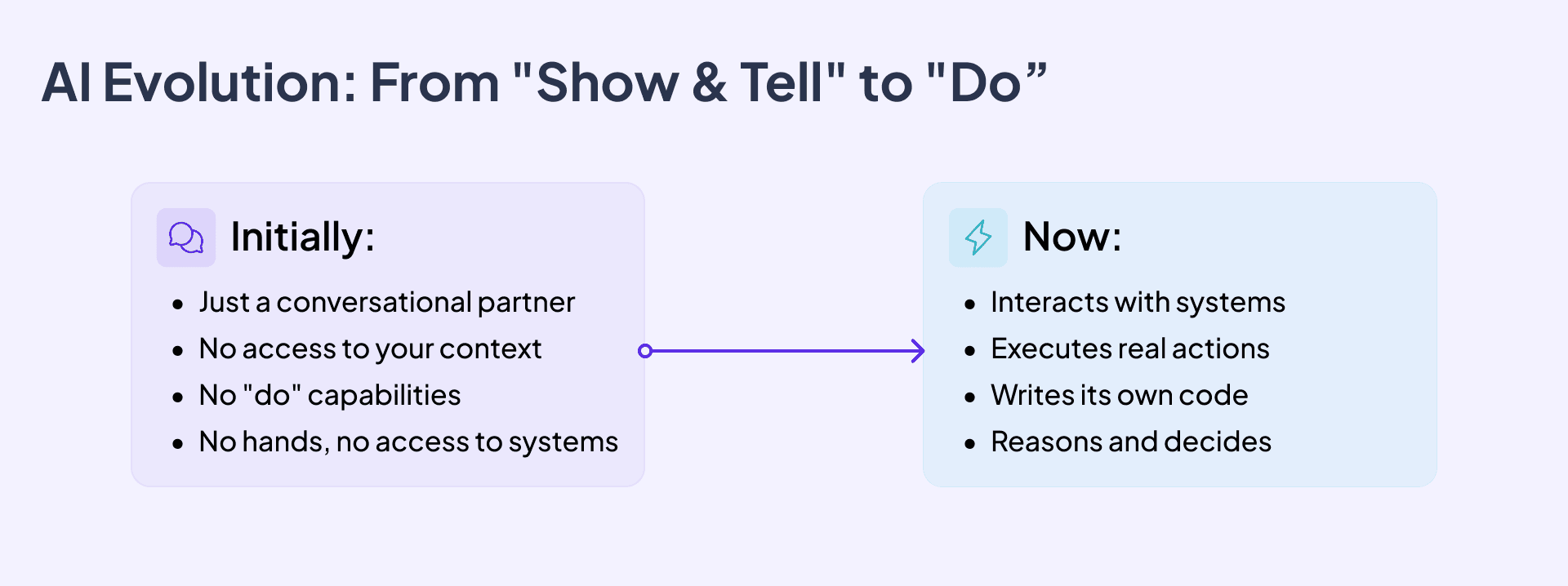
In the last couple years, AI has made the leap from conversation partner to independent worker. It no longer just answers — it reasons, decides, and executes. It can be given a task, a set of rules, and access to the right systems, and it will get the job done without someone sitting behind a keyboard.
This is what people mean when they talk about AI agents.
For operating partners, the implication is significant. Done right, agents can be built once and scaled across an entire portfolio. The same logic that automates e.g. customer order intake in one portco can, with proper foundations in place, be replicated in the next. That's a fundamentally different value creation proposition than anything we've had before.
But we're not quite there yet. The technology is ready. The standards are still emerging. And most portfolio companies have some foundational work to do before any of this becomes possible at scale.
The question isn't whether to act. It's how to act now, in a way that positions your portcos to move fast when the window fully opens.
What an AI agent is
From chatbot to worker
Early AI tools were reactive. You prompted, it responded. Each interaction was independent — no memory, no follow-through, no consequence.
AI agents are different in one fundamental way: they take action.
An agent is given a goal, access to tools and systems, and the ability to reason through a sequence of steps to complete it. It can read a document, extract the relevant data, populate a field in your ERP, send a notification, and log the result — all without a human touching it.
Think of it less like a search engine and more like a specialist colleague. One who is very good at a very specific job, never gets tired, and can do it a thousand times a day.
Definition of AI Agent
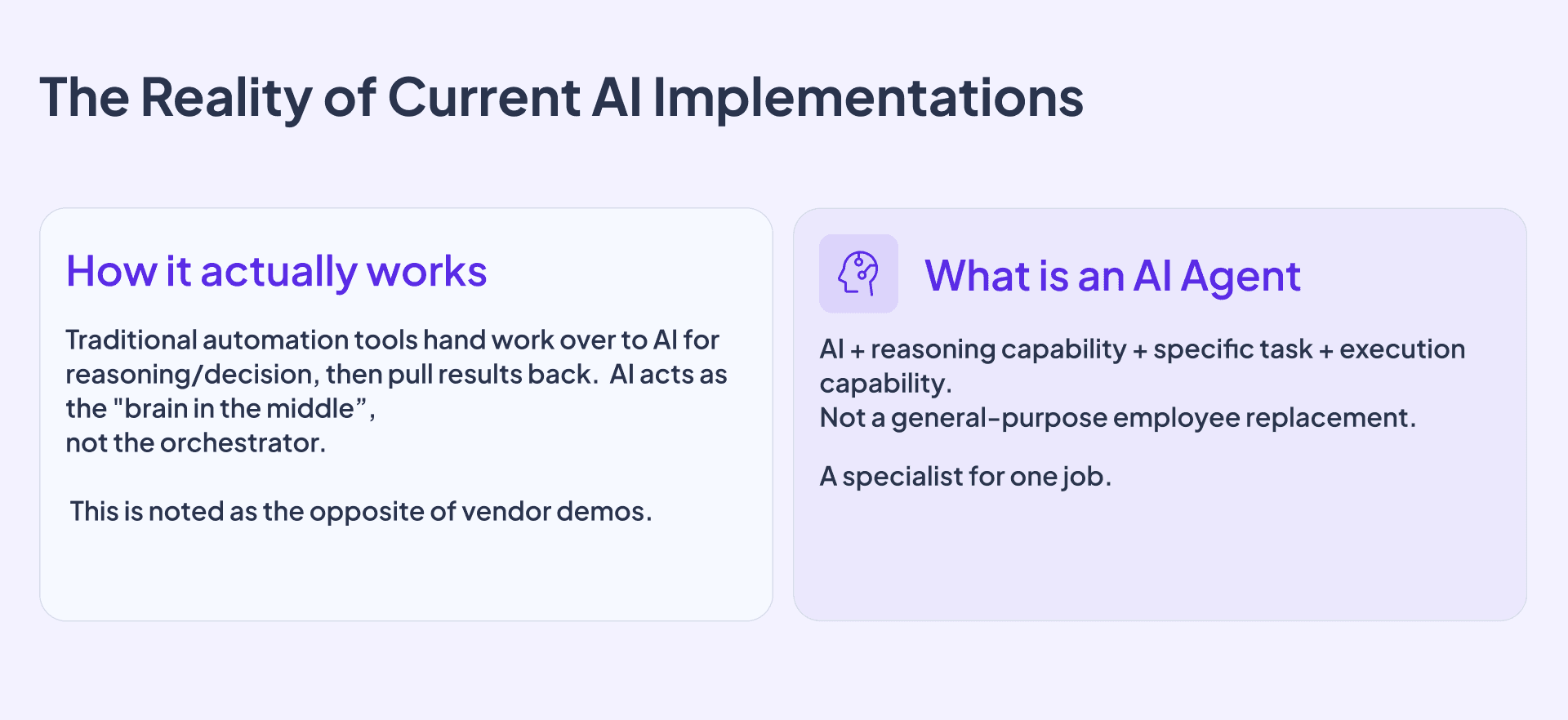
An AI agent is: an AI model + reasoning capability + a specific task + the ability to execute.
The "reasoning capability" is what makes the difference. Traditional automation follows rigid rules — if X, do Y. The moment something falls outside those rules, it stops. A file saved in an unexpected format, a typo, a customer who writes their order differently than the template expects — any of these can bring the whole process to a halt. Someone then has to find the problem, diagnose it, and fix it before the automation can continue. The system is as resilient as the rules you wrote for it.
An AI agent can handle ambiguity. It can look at an email order written in three different formats by three different customers, understand what each one is actually asking for, and structure the data correctly in every case. It doesn't need a human standing by to catch every exception. It flags the things it genuinely can't resolve and gets on with everything else.
What AI agents are not
Before deploying anything, it's worth being clear on what agents cannot and should not be expected to do.
- They are not a general-purpose employee replacement. An agent cannot do everything a good operations manager does. What it can do is take the manual, repetitive, data-heavy work off that manager's plate — freeing them to do the things that actually require a human.
- They are not a silver bullet. This bears repeating. The single most expensive AI mistake we see in portfolio companies is buying a system because it has "AI built in" — and expecting results to follow automatically. A new ERP with a native AI layer is not an automation strategy.
- They are not a substitute for data readiness. If your data is fragmented, incomplete, or locked inside systems that don't communicate, an AI agent won’t save you. It needs clean, accessible, structured data to work from. Every AI project starts with a data infrastructure project.
- They are not human replacements. AI Agents require supervision and guardrails — a human in the loop who will react in edge cases and oversee the process as a whole. Otherwise — as experiments with AI running its own virtual computer show — it can easily go off track, make decisions that only partially make sense, and start hallucinating, e.g. fabricating that it had received non-existent payments. It can't be let loose.
With AI Agents, the person supervising effectively becomes super-productive. When done right, AI raises productivity by orders of magnitude.
One agent, one job
The most effective agents are focused. An agent that reads and structures incoming orders is not the same agent that monitors overdue receivables. An agent that enriches your CRM contacts is not the same one that handles shipment notifications.
Narrow scope means easier testing, faster deployment, and lower risk. You know exactly what it's doing, and you know when it's not doing it right.
Build a portfolio of focused agents. Not one agent trying to run everything.
Where AI agents deliver real results
Across our implementations, three categories of use cases consistently deliver strong outcomes:
1. Information structuring
This is the most accessible entry point, and often the most immediately valuable.
AI agents are exceptionally good at taking unstructured inputs — emails, PDFs, voice messages, scanned documents — and turning them into structured data that can flow through your systems.
The clearest example is order processing. Customers send orders in every format imaginable. From a dedicated portal, to spreadsheets, and emails. An AI agent reads all of them, identifies what was ordered, validates it against your product catalogue, flags discrepancies, and drops it into your ERP. Instantly. Without a person touching it until the final sign-off.
2. Manual jobs processing automation
All the small, high-volume, labour-intensive operations that happen every day inside your portcos collectively eat significant time and create error risk:
- Sending shipment notifications to customers when an order ships.
- Updating prices in the system when supplier costs change.
- Blocking customer accounts that have exceeded their payment terms.
- Helping reconcile accounts where payments don't perfectly match invoices.
None of these require strategic thinking. All of them can be handled by a well-designed agent operating inside your existing systems. And collectively, they represent hundreds of hours a week of your team's time.
3. Data intelligence
Once you have clean, consolidated data, AI agents can become a live intelligence layer across your business.
Instead of waiting for weekly reports or asking your BI team to build a new dashboard, your commercial director can ask a question in plain English: "Which accounts have dropped more than 15% in order value in the last 90 days?" or "Which product category is underperforming against last quarter's forecast in the Nordics?"
The agent queries the data, interprets it, and responds in natural language. Real-time insight without a data analyst in the loop. This is particularly powerful in sales and operational decision-making, where speed of insight drives speed of action.
How AI agents actually work inside enterprise systems
There is a gap between how AI agents are typically demoed and how they function in the real world.
In vendor demos, you usually see an AI agent orchestrating an entire process end-to-end — reading, reasoning, deciding, executing, monitoring, looping. It looks seamless.
In practice, the architecture is different. In approximately 95% of the real-world enterprise implementations we run, traditional automation tools — RPA, workflow automation, low-code and no-code platforms — still do the heavy lifting of orchestration. They manage the sequencing, handle the integrations between legacy systems, and ensure reliable execution.
AI comes as the** brain in the middle**.
The workflow automation picks up an incoming order email. It passes the content to the AI, which reads it, extracts the structured data, applies reasoning to resolve any ambiguity, and returns the clean output. The workflow automation then takes that output and populates the ERP.
Neither system could do this alone. Traditional automation can't handle unstructured input. The AI can't reliably manage the complex integration layer with legacy systems on its own.
The combination is what makes this work. And understanding this architecture matters — because it tells you what investments are actually needed to make agents functional, and where the most common implementation mistakes happen.
This will evolve. Agents are becoming more capable orchestrators. But for now, traditional automation and AI work best together, not in competition.
How to start: a practical path for Operating Partners
The path from "we want to do something with AI" to a running agent that's delivering results looks the same in most of our engagements. Here's the framework.
Step 1: Data audit
Before anything else, understand what data you have, where it lives, how old it is, and what quality it's in. You need to know:
- Which systems hold the data that matters?
- What are the formats?
- Is it reliable?
- Is it up to date?
- Are there obvious gaps?
Skipping this step causes expensive failures later. You cannot build reliable automation on unreliable data.
Step 2: Data consolidation
Most portcos have their data spread across multiple systems that don't talk to each other — an ERP, a CRM, a handful of spreadsheets that someone built ten years ago and has maintained since.
Before agents can work across the business, that data needs to be pulled into a single, accessible place — or at least mapped and connected so the AI can reach across sources without losing context. Ideally it lives in a data warehouse, a data lake, or a well-designed integration layer. The goal is one source of truth, or a coherent view of many, that your AI can reason against.
Step 3: Data quality and pipeline stability
Consolidation is not enough. You also need to ensure that the data flowing into your central store is clean, complete, and consistent — and that it keeps flowing without interruption.
Data cleansing and stable data pipelines are the infrastructure layer that makes everything downstream possible. An AI agent reasoning against stale or corrupted data might cause more damage than having no agent at all.
Side note: if your AI agent can't do it, it typically means your teams aren't performing it well either — you just don't see it beneath the surface.
Data pipelines can be compared to roads connecting cities. No autonomous vehicle, even the best-designed one, will be able to drive from one place to another if there are no roads. It's the same with data pipelines and system integrations.
Step 4: Discovery — find the right first problem
Once your data foundations are in place, the next step is identifying where to start. Our piece on ROI from automation in private equity covers this in depth — but the short version is: look for high-volume, manual, error-prone processes where speed and accuracy matter and where the outcome is measurable.
Talk to department heads. Ask operations managers where their team spends the most time on work that "feels like it should just happen automatically." The answer is usually obvious, once you know where to look.
The most common entry points we see: order processing, invoice handling, accounts receivable collections, CRM data maintenance, shipment communications, customer and vendor onboarding, compliance, customer service, sales augmentation, demand prediction, financial reconciliations etc.
Step 5: Map the process end to end
Before automating anything, map the full process — from trigger to completion. What kicks it off? What decisions get made? What systems are touched? What are the edge cases? Who is involved in the process?
This step surfaces the complexity that gets missed when people just describe the process from memory. It also tells you where AI reasoning is genuinely needed versus where a simpler rule-based approach will do the job.
The process map is still the king.
Step 6: Traditional automation first — agents on top
Build the automation backbone using robust, proven tools. Get the orchestration right. Then layer the AI agent in where reasoning is needed.
Starting with the agent and trying to work backwards into the integration layer is one of the most common and costly mistakes in this space. The sequence matters.
Step 7: Scope, roadmap, execute
With one well-mapped process and a clear architecture in mind, build a proper project scope. Define what done looks like. Set realistic timelines. Get business ownership on the portco side — someone who cares about the outcome and will champion adoption internally.
Then execute. A controlled, well-governed implementation is worth more than an ambitious proof of concept that never makes it to production (i.e. it’s never launched and used).
Step 8: Test, then scale
Run the pilot until you're confident it works — not just technically, but operationally. Does the team trust it? Are the outputs accurate enough to act on without manual review? Are the edge cases handled correctly?
Once you have that, you have something you can replicate. The same agent architecture, applied to the next portco with similar challenges, should take a fraction of the time and cost of the first. That's where the portfolio-level value starts to compound.
When not to use AI agents
Not every problem is an AI problem. And pushing AI into the wrong context creates more cost and confusion than it solves.
- Very old legacy systems. If a portco is running core operations on systems built in the 1980s or 1990s connecting AI agents to those systems is rarely practical. The integration challenge alone can be insurmountable without major prior investment.
- Fragmented, unstructured, uncontrolled data. If no one knows where the data lives, who maintains it, or whether it can be trusted, you are not ready for agents. Fix the data problem first.
- Processes where simple automation is enough. AI is an additional layer of sophistication — and sophistication comes with additional cost, complexity, and maintenance requirements. If a straightforward RPA script or workflow automation rule can handle a process reliably, use that. Don't add AI to a problem that doesn't need it.
The principle is simple: you don't need a Swiss knife to cut bread, same as you don't need AI to solve a problem that simple workflow automation can handle.
McKinsey: what agentic AI looks like at scale
McKinsey is the clearest case study to show a concrete picture of where this is heading.
The company has approximately 40,000 employees. They have built approximately 25,000 AI agents — roughly 0.6 agents per employee. These agents handle the work that used to sit in back-office functions: research, data synthesis, document generation, analysis, internal workflows.
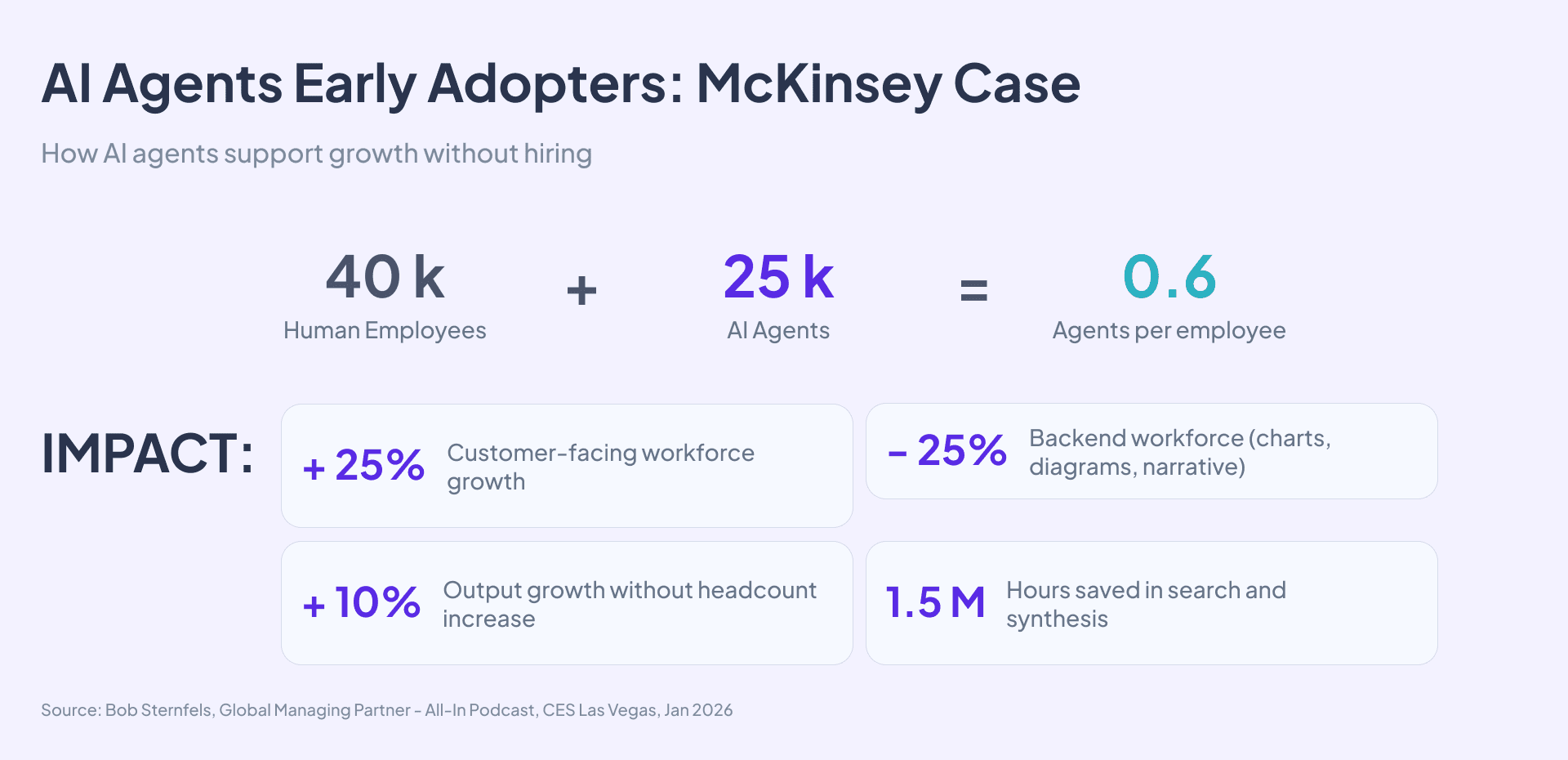
McKinsey was able to shift approximately 25% of their back-office workforce into client-facing roles. The agents absorbed the operational volume. The people went where human judgement and relationships matter.
Most significantly: McKinsey can grow revenue without growing headcount. That is a structural change to their business model. The relationship between revenue and people has fundamentally changed.
For PE-backed businesses, where EBITDA expansion and scalable operations are the core value creation thesis, this is the proof point that matters. The question is how quickly your portcos can build toward it.
AI agents in action: order processing in a manufacturing portco
One of the most reliable first deployments we run in manufacturing and distribution businesses is AI-powered order processing.
In a typical portco in this sector, incoming orders arrive through multiple channels: EDI, email, phone, and customer portals. Each one looks different and requires someone on the operations team to read it, interpret it, validate it against the product catalogue and pricing, and enter it into the ERP.
In a business processing hundreds of orders daily, this is a significant manual load. It's also a source of errors — misread part numbers, incorrect quantities, wrong pricing tiers — that create downstream problems in fulfilment, invoicing, and customer satisfaction.
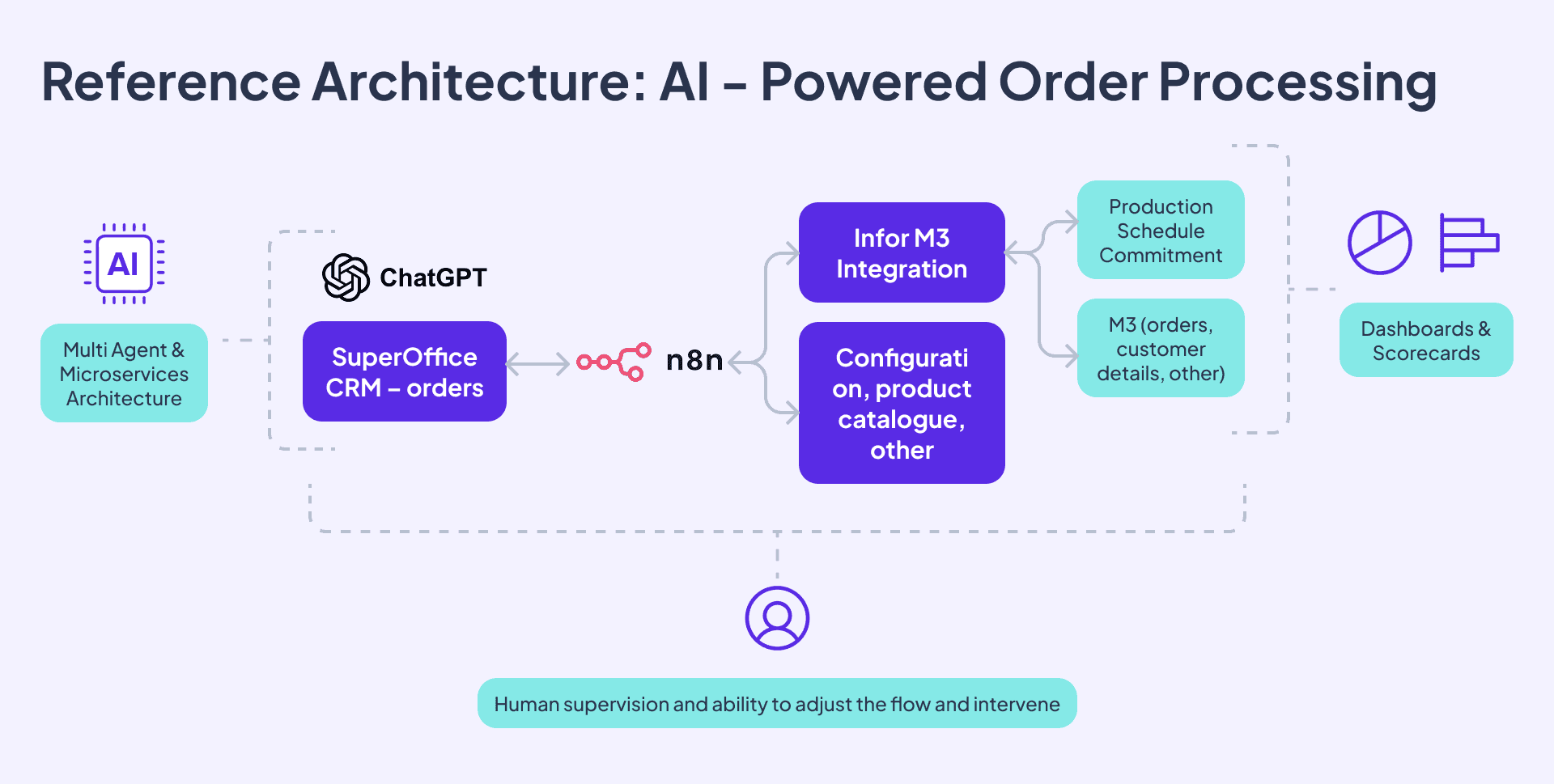
The agent-based solution works like this: workflow automation monitors the inbound channels and routes each incoming order to the AI agent. The agent reads the order — regardless of format — extracts the relevant fields, maps them to the correct product codes and pricing, validates for completeness, and flags anything it can't confidently resolve. The validated output is then passed back to the workflow automation, which enters it into the ERP. Human review is reserved for exceptions.
The result is faster processing, fewer errors, and freed-up capacity for the operations team to focus on the exceptions, the customer relationships, and the issues that actually need human involvement.
And once it works in one portco — the architecture, the agent logic, the integration patterns — it can be replicated as a part of the portfolio playbook.
Check out more examples in the recent publication.
Where to start if your portco isn't ready yet
A significant number of portfolio companies are not close to being ready for AI agents — not because the technology doesn't apply, but because the foundational infrastructure isn't there.
We regularly walk into portcos that are still running core operations from a combination of a fifteen-year-old ERP and a set of Excel files that one person maintains and no one else fully understands. AI is not a distant horizon for these businesses — it's an entirely different conversation. You need to extract them from that situation first.
That doesn't stop you from moving forward. Investing in the foundations: data structure, system integration, process documentation, and change management will make everything else possible.
The companies that will move fastest on agentic AI in two years are the ones whose operating partners are making this tedious groundwork today.
Interested in identifying where AI agents can create value in your portfolio? Get in touch with the GGS team!